Set Up GCC in India: Your End-to-End Guide for Global Growth
Global businesses today are no longer asking whether to build offshore capabilities—but where and how. If you’re a business owner, investor, policymaker, or enterprise leader exploring your next growth move, chances are you’ve heard the buzz around Global Capability Centers (GCCs).
And there’s a reason for it.
India has emerged as one of the most compelling destinations to Set up Gcc in India, combining scale, talent, incentives, and long-term strategic value. This blog is designed to be your friendly, no-nonsense guide—drawing insights from a comparative global analysis of GCC incentives and support mechanisms—to help you confidently plan your GCC journey in India.
Let’s break it down, step by step.
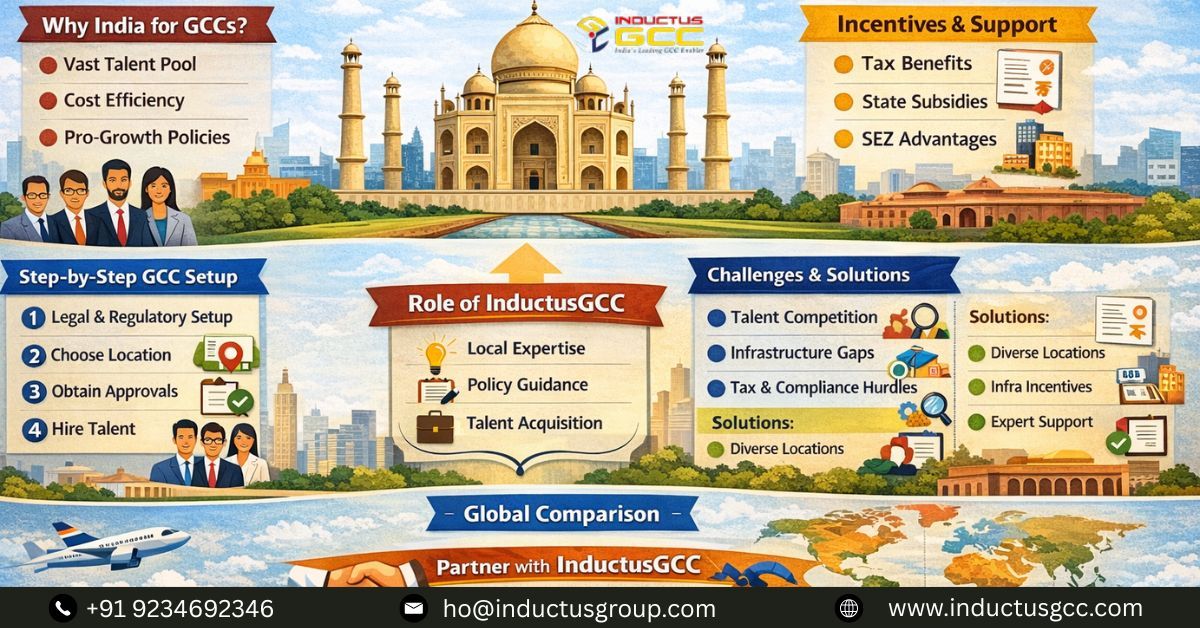
What Is a GCC—and Why India Leads the Global Conversation
A Global Capability Center (GCC) is a captive offshore unit set up by multinational companies to deliver high-value services such as IT, engineering, R&D, finance, analytics, and digital transformation. Unlike traditional outsourcing, GCCs are deeply integrated with the parent organization’s strategy, culture, and innovation roadmap.
So why do so many global firms choose to Set up Gcc in India?
The answer lies in a powerful mix of talent depth, cost efficiency, policy support, and ecosystem maturity—a combination few countries can replicate at scale.
According to the comparative analysis in the referenced PDF, India consistently outperforms other GCC destinations across key parameters such as talent availability, government incentives, scalability, and innovation readiness.
This blog uses those insights to help you understand why, how, and what’s next when you set up a GCC in India.
Why Set up Gcc in India: The Strategic Advantage
1. Unmatched Talent at Global Scale
India offers one of the world’s largest pools of skilled professionals across:
- IT and software engineering
- Data science and AI
- Product development and R&D
- Finance, compliance, and analytics
Compared to destinations like Poland or Mexico, India’s sheer scale of STEM talent stands out. The PDF highlights that India produces millions of graduates annually, ensuring long-term workforce sustainability for GCCs.
2. Cost Competitiveness Without Compromising Quality
While countries like the Philippines excel in voice-based services, India dominates high-value, knowledge-intensive GCC operations—often at 30–50% lower operational cost than developed markets.
That’s a big reason global enterprises continue to Set up Gcc in India even as other regions compete aggressively.
3. Government Policies That Encourage GCC Growth
India’s central and state governments actively support GCC expansion through:
- Tax incentives and exemptions
- SEZ and non-SEZ benefits
- Capital and operational subsidies
- Fast-track approvals
When compared with Mexico or Eastern Europe, India offers broader and more customizable incentive frameworks, especially at the state level.
Overview of GCC Incentives and Support in India
One of the most valuable insights from the PDF is how India’s incentive structure is layered, offering benefits at multiple levels.
Central-Level Incentives
- Corporate tax reductions for new manufacturing and service entities
- SEZ benefits including tax holidays and duty exemptions
- Simplified compliance frameworks for foreign entities
State-Level Incentives (Illustrative)
Different states compete to attract GCCs, offering:
- Capital subsidies for office setup
- Payroll-linked incentives
- Stamp duty and electricity duty exemptions
- R&D and innovation grants
Text-based snapshot comparison:
- India: Multi-layered incentives + talent scale + policy flexibility
- Philippines: Strong BPO incentives, limited R&D depth
- Poland: EU market access, higher labor costs
- Mexico: Proximity to US, fewer tech-focused incentives
This is why India continues to rank as a top choice to Set up Gcc in India for long-term, innovation-led operations.
Step-by-Step Guide to Set up Gcc in India
Let’s make this practical.
Step 1: Choose the Right Legal Structure
Most GCCs operate as:
- Wholly Owned Subsidiaries (WOS)
- Limited Liability Partnerships (LLP)
Each structure has implications for taxation, compliance, and profit repatriation.
Step 2: Regulatory Approvals and Registrations
You’ll need to complete:
- Company incorporation under Indian law
- PAN, GST, and tax registrations
- FEMA and RBI compliance for foreign investment
This is where expert support can save months of effort.
Step 3: Select the Best Location
Popular GCC hubs include:
- Bengaluru – technology and innovation
- Hyderabad – cost-efficient and policy-friendly
- Pune – engineering and automotive talent
- Chennai – manufacturing and R&D strength
- NCR – consulting, finance, and analytics
States often tailor incentives based on city selection—another reason planning matters when you Set up Gcc in India.
Step 4: Engage with Government and Industry Bodies
Working closely with:
- State investment promotion agencies
- Industry associations
- GCC-focused enablers
can unlock faster approvals and better incentive packages.
Role of InductusGCC and the Support Ecosystem
This is where execution meets expertise.
Why InductusGCC Matters
InductusGCC acts as a strategic bridge between global enterprises and India’s complex but rewarding GCC ecosystem. Instead of navigating regulations, talent markets, and incentives alone, companies gain a structured, guided path.
InductusGCC Enabler Programs
The InductusGCC Enabler framework supports companies across:
- Market entry and feasibility
- Policy and incentive mapping
- Talent acquisition strategies
- Compliance and operational setup
A simple scenario (gccInducutus in action):
A European fintech firm wants to build a 300-person analytics GCC. Through gccInducutus, the company identifies the right state incentives, sets up operations in under six months, and builds a future-ready talent model—without regulatory friction.
That’s the power of the right ecosystem partner when you Set up Gcc in India.
Challenges in GCC Setup—and How to Solve Them
No destination is without challenges, and India is no exception.
Common Obstacles
- Talent competition in top cities
- Infrastructure disparities across regions
- Tax interpretation complexities
- Compliance overload for first-time entrants
Practical Solutions
The PDF highlights how successful GCCs mitigate these challenges by:
- Diversifying location strategies (Tier-2 cities)
- Leveraging state-specific infrastructure incentives
- Partnering with experienced enablers
- Building long-term talent pipelines
Countries like Poland and Mexico face similar issues—but India’s ecosystem maturity gives it a stronger edge in solving them.
Comparative Perspective: How India Stacks Up Globally
Drawing from the PDF’s comparative tables:
- India offers higher incentive flexibility than Eastern Europe
- Talent scalability exceeds Southeast Asia
- Innovation readiness outpaces Latin America
While the Philippines shines in cost-efficient BPOs, and Poland benefits from EU proximity, India remains the most balanced destination for enterprises looking to Set up Gcc in India for both efficiency and innovation.
Future Outlook: What’s Next for GCCs in India
The future looks promising—and dynamic.
Key Trends
- Rapid growth in AI, semiconductor, and deep-tech GCCs
- Expansion into Tier-2 and Tier-3 cities
- Increased policy focus on R&D-led GCCs
- Stronger academia–industry collaboration
Platforms like InductusGCC and models such as gccInducutus are well-positioned to support this next wave of growth by aligning policy, talent, and execution.
Conclusion: Your GCC Journey Starts Here
If you’re considering your next strategic move, now is the time to Set up Gcc in India.
India offers:
- Scale without compromise
- Incentives that reward long-term investment
- A mature, future-ready GCC ecosystem
With the right planning—and the right partners like InductusGCC or a dedicated InductusGCC Enabler—your GCC can become a true engine of global growth, not just a cost center.
Learn more, reach out, and start planning your GCC journey today.
The opportunity is real—and India is ready.